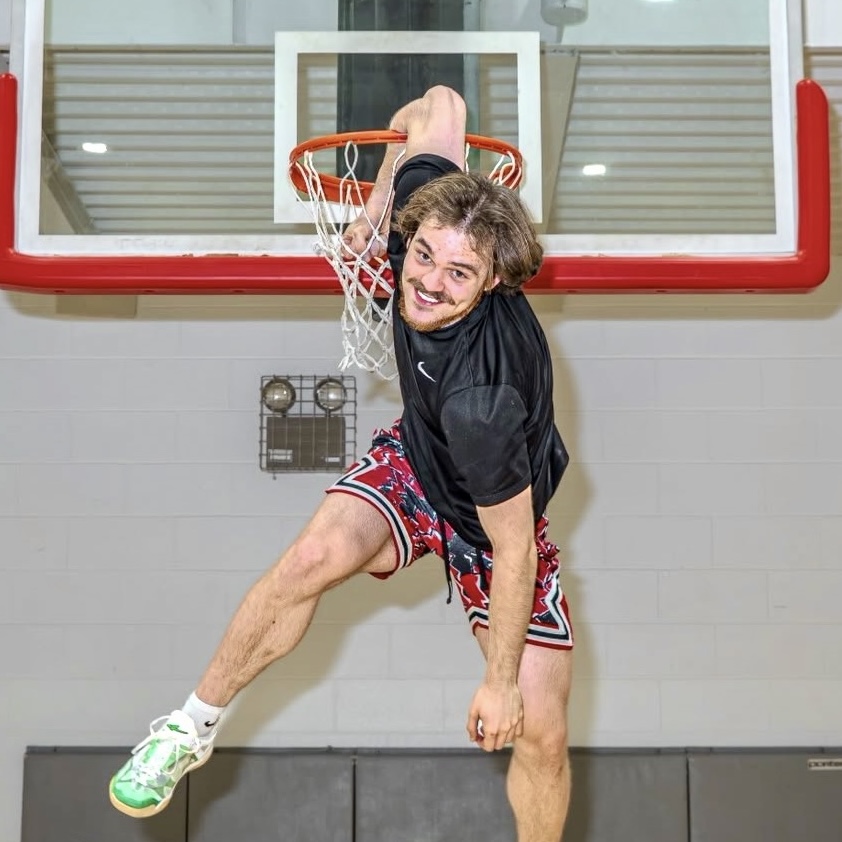
When I sat in with Dylan Haugen and Jeremiah Walker for Dunk Talk episode 73, Jeremiah was 20 and already flying to dunk contests across Europe and beyond. As another dunker, I wanted to hear how he had moved from jumping on school rims to making this his work.
His answer was less a sudden breakthrough than a long stretch of showing up. Jeremiah did not start with a grand plan. He started on low rims in London, kept jumping, and found a coach who told him pro dunking could be a real job.
He found dunking before he knew it was his sport
Jeremiah grew up playing soccer with his family. At eight, a friend suggested basketball because he was tall. His school had a netball hoop that stood around five feet ten inches, and the kids used it to try different dunks during lunch.
He told us dunking became the fun part before he understood that it was the part he cared about most.
At secondary school, the rims ranged from nine feet to regulation height. Jeremiah said he could dunk on the lower rims by 11, then got his first dunk on a 10-foot hoop at 12. It was a putback over a friend, the kind of moment you remember clearly. But making it once did not mean he had mastered it.
He said it took two or three years before he dunked on 10 feet again.
“I was literally just at a court every single day doing max jumps.”
That line stayed with me because it describes the long stretch behind the highlight. Jeremiah kept jumping through his teens, even when he was not close to another dunk. He learned by watching YouTube, studying approach mechanics, then going out and trying things for himself. I recognized that mix of copying, experimenting, and accumulating reps.
A coach helped him see a career
Jeremiah initially wanted to play professional basketball. His teams mostly used him for dunking, but he did not know that a person could make dunking a full-time job. When he was 16, an assistant coach told him to stop pursuing basketball and look up Joel Henry, a professional dunker. Jeremiah started researching what events and contests could offer.
By 16 or 17, he had decided to leave games behind and focus his training on dunking.
That advice landed differently for me because I heard the opposite growing up. In North Carolina, people around me asked why I was spending so much time jumping instead of playing basketball. Dylan described getting the same reaction in Minnesota.
Jeremiah had someone close to the game point toward a path that the rest of us had to piece together later. The difference was not that his coach made the decision for him. The coach gave him a name to look up and a possibility he had not considered.
Jeremiah also talked about what training meant to him. He began strength work around 18 after worrying about his knees and Achilles. He said he mainly thinks about protecting himself, while his years of jumping built the technique he still uses. I would not turn one athlete’s routine into a prescription for everyone.
The first prize made the job feel real
Jeremiah’s first contest, Ball Out in 2021, did not go well. The next year, a contest hosted by clothing brand 4QS offered £500 to the winner. Jeremiah made an off-the-bounce East Bay, a windmill reverse, and a windmill over a person. He also cleared three people and took the prize.
That was the first time he started thinking that dunking might become more than something he did for fun.
His approach to over-the-person dunks also showed how much he cared about doing something difficult. He said he noticed everyone attempting double-ups and decided to jump over people instead, even though it took more energy. He said he had cleanly cleared five people, describing the setup as starting with someone around six feet two inches tall.
He joked that six was a different story because he kicked people on the way through. That kind of detail made the achievement easier to picture than a list of contest results.
A trip for a dunk contest took Jeremiah to NEOM in Saudi Arabia, where he found himself in the desert just after finishing school. He described the contrast with London as eye-opening. Traveling for dunking suited him because he already loved visiting new places.
Now he could fly to an event, compete, and explore a city he might not have visited otherwise.
Latvia gave him the crowd he wanted
Asked to name a favorite event, Jeremiah chose Ghetto Games in Latvia for the atmosphere. He remembered thousands of people, a crowd that understood the dunks, and a reception that made him feel welcome. He talked about arriving in a Porsche with his flag, walking into the event, and hearing the crowd respond.
He also loved the extra activities around the contest, especially bungee jumping.
I have competed in front of crowds that were still learning how to read a dunk. Jeremiah described something different: people who knew the culture and could recognize why one dunk was harder than another. He said he wanted to return and joked that Latvia made him want to move there.
That response connects to what Jeremiah wants for dunking. He hopes more dunkers can make the sport their full-time work, and he wants the community to keep supporting people at every level. He wants more dunkers to come out of London and England, and he wants newcomers to feel the welcome he received.
Long videos let people see the work
One of my favorite moments came when Jeremiah explained why he started posting full dunk sessions on YouTube. He told Dylan he watched Dylan’s videos regularly, then remembered watching the two of us discuss long-form dunk sessions and wondered why he was not filming his own sessions the same way.
He decided to set his tripod horizontally and upload 10- or 20-minute videos.
He wanted viewers to see his attempts, his progress, and the parts that do not fit into a short highlight.
“If I watch other people dunk on long form, why wouldn’t other people wanna watch me?”
That is the question I want more dunkers to ask themselves. A short clip can show a make. A full session can show the attempts, the adjustments, and how consistently a dunker can land a skill. Jeremiah said long videos helped people see what he was doing and how much he was progressing.
I have written about why dunkers should post long-form content, and hearing him describe his own reason for doing it made the point hit home.
His route has kept changing. He posts short clips, makes longer videos, travels to contests, and talks openly about wanting to be known for his personality as well as his dunking. He told us he wants to be remembered as consistent, someone who showed up and did not miss. I did not hear that as a finished legacy.
For a closer look at the work behind that career, read about what professional dunking involves or how I documented my own path into dunking. Jeremiah’s story adds a lesson I still believe: the right opportunity can help, but the years of practice and the videos that show the work are what make that opportunity visible.