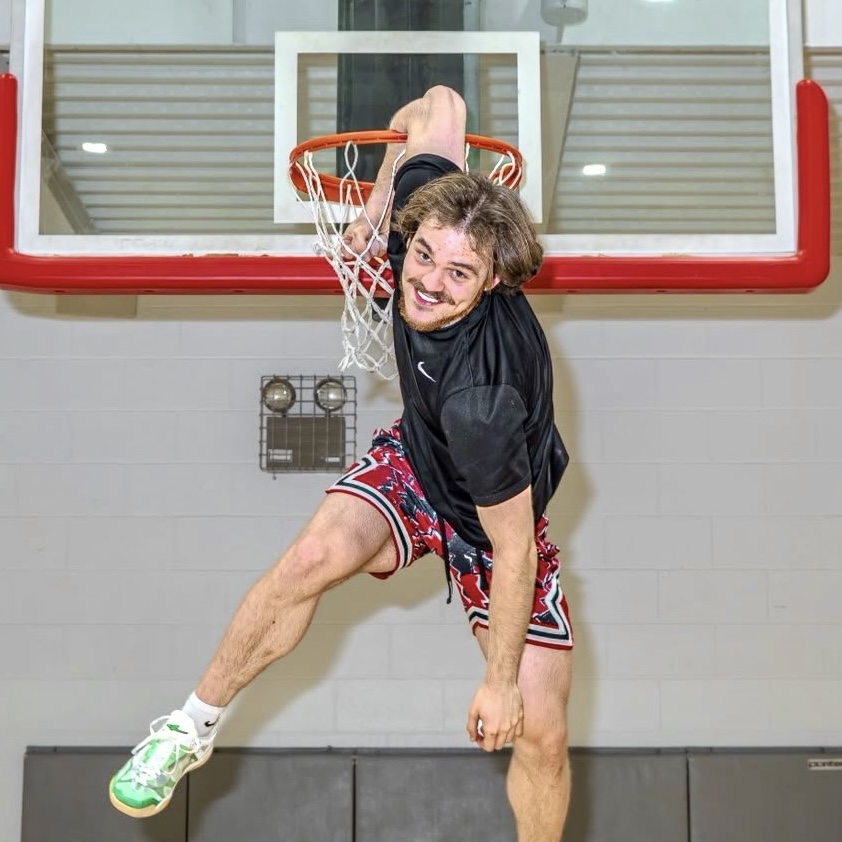
I’m Travis Reynolds, a professional dunker from North Carolina. Episode 21 of the Dunk Talk Podcast was the first time I sat down and told my whole story start to finish — the chubby-kid years, the forty-pound cut, the ten months it took me to land a single dunk, and the injuries that still shape how I train today. The full episode is at the top of this page, and the show’s own write-up lives on the Dunk Talk episode article. This is that story in my own words.
A chubby kid who got bit by the jump
I was never the athletic one growing up. I played a handful of sports and didn’t stand out at any of them, and I carried a lot of extra weight the whole time. Then around eleven or twelve I watched a kid in my class touch something I couldn’t get anywhere near, and that was it — I got obsessed with jumping. In the summer of 2014 I found out professional dunking was even a thing when Jonathan Clark’s 360 elbow dunk showed up on my feed. Not long after, I started following Isaiah Rivera from basically his first dunk, and I’ve watched his whole career unfold ever since.
My first dunk, then a year and a half of nothing
I got my first real dunk on a ten-foot rim in April 2018, when I was fifteen. I thought that was the breakthrough. Instead I hit a wall for about a year and a half — basic one- and two-handers and nothing else. I was around 210 pounds, jumping every single day with no structured training and no real warmup, just grinding myself into the ground. At the end of 2019 my knee finally said enough and I got diagnosed with proximal patellar tendinopathy. That was the low point, but it was also the wake-up call.
The 40-pound cut that changed everything
From the end of 2019 to June 2020 I cleaned up my diet, trained with real consistency, and dropped from 210 to 170 — forty pounds in about six months. That cut alone put meaningful inches on my vertical before I’d added a single new training method. Around the same time I got serious about lifting through THP, which finally gave me structured strength work and load management instead of the daily beatdown I’d been giving myself. That’s when the trick dunks started unlocking: windmills, then tomahawks, and eventually the one I’m known for.
Ten months for one dunk
People assume the behind-the-back came fast. It did not. From January 2020 to October 2020 I worked it every single session on a lowered rim — ten straight months for one dunk. When it finally clicked it became my signature, and it taught me the lesson that runs through everything I do now: pick the pattern, drill it relentlessly on low rim, and let the reps do the work.
Finding my people: the North Carolina Dunk Squad
Dunking is a lonely sport until you find your crew. Mine is the North Carolina Dunk Squad. Ben has been my best friend since we were three years old and started dunking back in 2014; he stepped away for college and came back to it full-time. Obi is 6’6″ and I met him through Instagram around 2019 to 2020. Dan Gross is about an hour and a half from me — we connected when Jordan Kilganon and Isaiah came through North Carolina during COVID — and Sam drives in from the Raleigh area, roughly three hours out, and brings elite energy every time. We rotate between my YMCA (ten minutes away, floor like an ice rink), Dan’s old high school “blue gym,” and High Point University’s facility in the off-season. I actually landed my best windmill ever at High Point with my earbuds in — I didn’t even hear it go down until I watched the film back.
In March 2021 I spent two weeks in Florida training with John Evans and the rest of the roster. Honestly it was more dunk vacation than boot camp — small technique tweaks and a lot of time building real friendships with Isaiah and the other dunkers I’d only known online.
Training around a back that won’t let me squat
The injury that changed my training the most wasn’t dramatic. Years of sloppy barbell technique early on quietly wore down my lower back, and now I can’t put a bar on my back to squat at all. Every leg session is Smith machine, hex-bar deadlifts, and machine variations. The honest part is I don’t know my true ceiling anymore — I believe I had more in the tank before the back went. I’ve also got quad tendinopathy that flares any time I overload, and after watching CJ Champion tear his Achilles I stopped taking mine for granted. So I train one, maybe two real sessions a week now, and I do a lot of low-rim standing work without jumping — the same method that unlocked the behind-the-back in the first place.
Dunk Camp 2024
Dunk Camp in Utah in 2024 was a gut check. The Thursday pre-show was the last straw for my knees — I could barely walk afterward. But I pulled it together for the Saturday contest and threw some of my best dunks, including an Eastbay elbow, on a rim that measured around 9’8″ to 9’9″. The lesson was expensive but clear: for someone with chronic knee stuff, a pre-show and a contest two days apart is a guaranteed quad pile-up. I’ll manage that differently next time.
The little things
A couple of details people always ask about. I’ve worn Nike Jordan Why Not 3.0s since 2020 — I’ve got wide, oddly shaped feet, most modern shoes slip or kill my arches, and if it’s not broken I’m not fixing it; I’m on my third pair. And I laser-measure the rim for almost every home session and post the exact height, down to something like 9’11.95″. People think that’s overkill, but it’s just data hygiene — if I want to track how my vertical moves week to week, I can’t have rim height as a hidden variable.
What’s next
The goals right now are simple to say and hard to do: put the behind-the-back over a person, get my Eastbay elbow contest-consistent, keep my back healthy through my mid-twenties, and earn my way into the DunkMan League, which fits my skill set. I went from an overweight kid who couldn’t touch rim to a pro who measures everything and still loves it as much as I did at twelve. That’s the journey — and it’s nowhere near done.