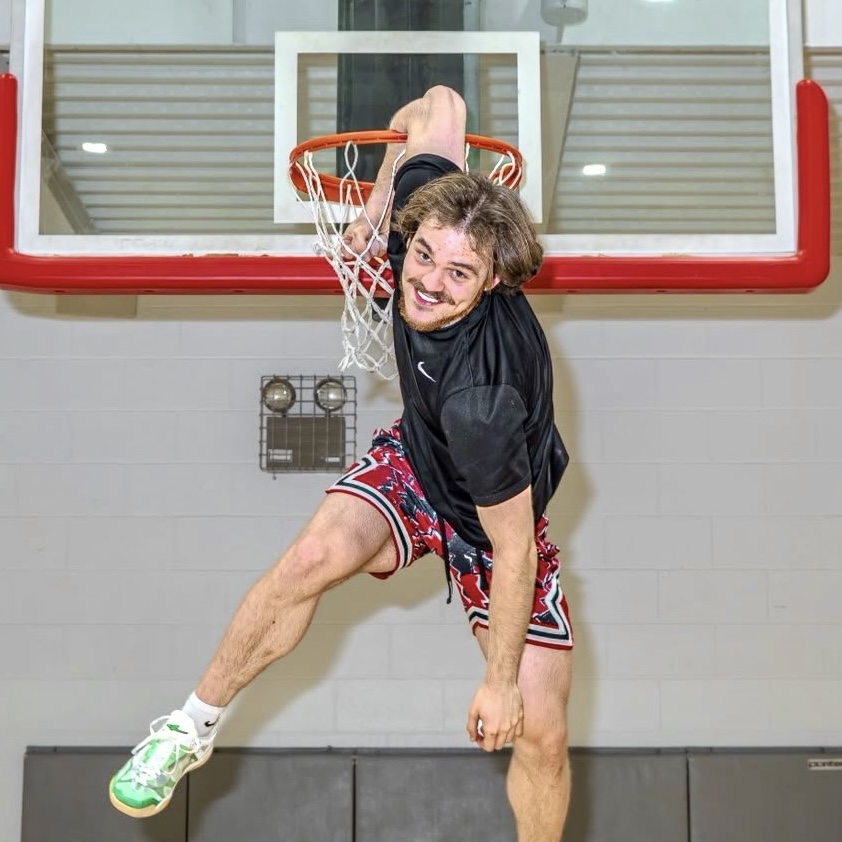
I’m Travis Reynolds, a professional dunker from North Carolina. Episode 54 of the Dunk Talk Podcast was all about the part of dunking nobody wants to train — the off-hand — and the broken finger that forced me to finally take mine seriously. The full episode is at the top of this page, and the show’s write-up is on the Dunk Talk episode article. Here’s what actually happened, in my own words.
The black band
Right before all of this, my right hand was the best it had ever been. I earned my WDA black band — a five-dunk gauntlet you have to complete in a single session: a 360 Eastbay, an Eastbay off the backboard, a 360 behind-the-back, a Scorpion, and an Underboth. There are no do-overs spread across days; you land all five that day or you start the gauntlet over, and that pressure is its own test. The hardest one for me was the 360 behind-the-back — I’m a left-right jumper finishing right-handed, so that pattern is technically brutal. Second hardest was the Eastbay off the backboard, only because I basically never do backboard passes. The thing that carried me through wasn’t talent, it was a process I trust now more than anything: film it, find the one specific fault, change a single variable, and retest.
The freak finger injury
Then I broke a finger on my right hand learning double-ups. I’d set my jumper too far from the rim, which meant I had to throw the finish hard toward the back iron, and the ball rattled straight back out into my finger and bent it backward. The diagnosis was damaged tissue and joint slippage that stopped just short of a full dislocation — seven weeks in a splint, then a stretch with finger extension and flexion trainers I ordered off Amazon to claw the range of motion back.
This was actually my second push-off injury. My first real attempt over Jordan Kilganon in Canada went wrong and I quit doing them for a full year. So if there’s one thing I’d tell anyone learning to dunk over people: place your person closer than you think. On a push-off you travel up, not out, and the instinct to give yourself room is exactly what forces those wild, dangerous finishes.
Seven weeks of lefty bootcamp
Instead of sitting on the couch for seven weeks, I reframed the whole thing as an opportunity. My right hand had just cleared a black band; my left hand couldn’t reliably throw down a basic one-hander — a pure coordination deficit. That gap bothered me, so I went at it exclusively while the finger healed.
The plan was simple and boring, which is usually the sign it’ll work. First, low-rim work nearly every day, left hand only, purely to build coordination. Second, lefty shooting form — I believe ball control has to come before any dunk-specific training, so I reground the fundamentals with my off-hand until the ball felt like mine again. Third, and this is the one that unlocked everything, I trained the lefty Scorpion on purpose. By the end of the seven weeks I’d gone from shaky, inconsistent lefty windmills to landing them clean, and I threw my first ever left-handed Eastbay — a dunk I couldn’t have imagined attempting on that side two months earlier.
Your off-hand isn’t a backup
Here’s the professional argument. If you get booked for an event and your right hand breaks that week, what exactly is your plan? A pro needs a performable show in either hand, period. And beyond the insurance policy, there’s the creative side: half of Kilganon’s famous hundred-dunk variety exists because both of his hands work. Your off-hand isn’t a backup — it’s an entire second bag you haven’t opened yet.
Helping Ben find his reverse behind-the-back
A good example of the “film it, find the fault” approach in action: my training partner Ben Hopkins kept failing a straight-on two-hand behind-the-back. Watching it back, the problem was geometric — his Kilganon-style push gets him under the ball, which fights a face-up finish. So I told him to flip it to the reverse variant, where his natural motion only needs the second hand to join at the very end. He made it on his second attempt. It’s a rare dunk, and the fix was one variable.
How I’d tell you to start
If you want to build an off-hand, don’t start by chasing off-hand dunks. Start on a low rim, off-hand only, and just build the coordination — it will feel embarrassing, and that’s exactly the point. Then put a ball in that hand and rebuild your shooting form, because ball control has to come before anything dunk-specific. Only then go after the lefty Scorpion. It sounds backwards to attack one of the hardest control patterns early, but handling the ball behind your back where you can’t see it is what teaches your off-hand to truly feel the ball, and it drags a dozen easier dunks up with it.
The takeaway
Breaking my finger cost me seven weeks and gave me a second hand. That’s the pattern I keep coming back to: every subtraction becomes a curriculum. Film the rep, isolate the one fault, change a single variable, retest — and when your body forces you to stop doing the thing you’re good at, use the time to build the thing you’re not.