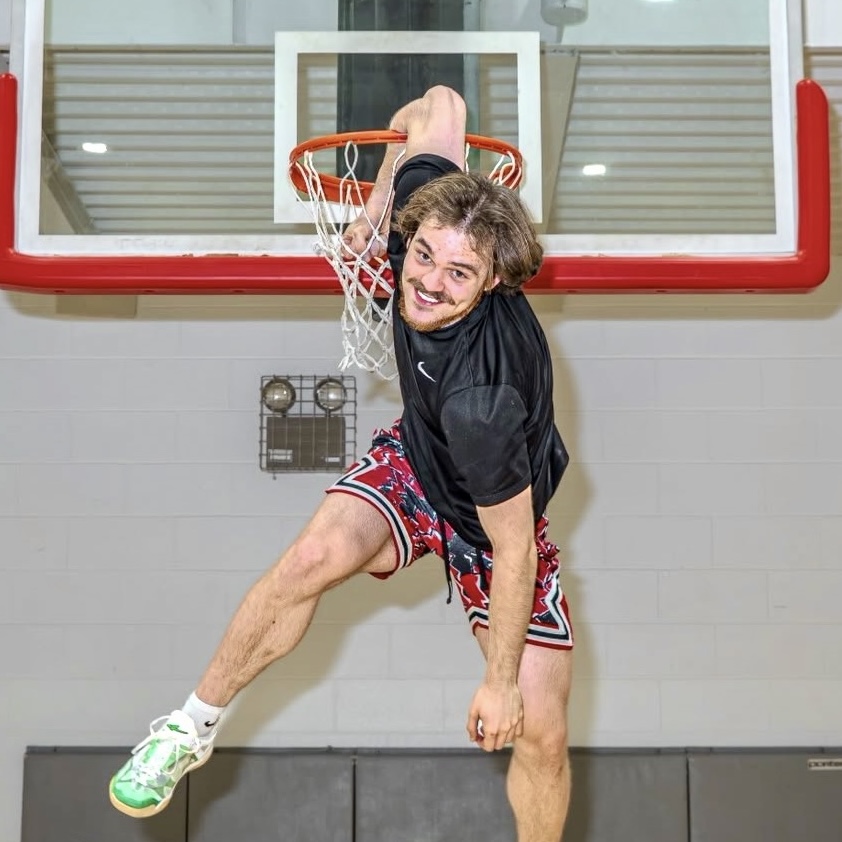
In Dunk Talk episode 68, Dylan Haugen and I watched the 2026 NBA Dunk Contest, then broke down four new Mac McClung dunks. The contest gave us very different things to react to: Carter Bryant’s opening reverse 360 windmill barely caught the rim, Jaxson Hayes struggled through a free-throw-line approach, and the cleanest finishes gave us a reason to enjoy the athletes even when an idea went wrong. Mac’s clips gave us a separate set of moves to judge on their own terms.
The first round showed how one miss changes a dunk
Carter Bryant opened with a reverse 360 windmill that barely caught the rim. The contact took the force out of the finish, even though the rotation itself looked good. That is a rough way to start a contest: the athlete can do most of the hard work and still have the rim decide what the crowd remembers.
Jase Richardson followed with a reverse windmill. The finish looked good, but the ball traveled too far into the basket, and the discussion shifted quickly to how it compared with Carter’s attempt. The early scoring already left us questioning how much room the judges had saved for a better dunk.
Carter’s score was 45.6, and the conversation kept returning to that baseline as later attempts received higher marks.
Jaxson Hayes brought real expectations with him because Dylan had seen footage of his free-throw-line windmill. In the contest, his stuttering approach took away the speed he needed for the distance. The discussion recognized the impulse to keep going after the approach breaks down. Once the rhythm is gone, trying to force the dunk can turn a difficult idea into an awkward finish.
Hayes’s sequence also raised a practical question about resets. A small contest may let a dunker explain that a pass or approach went wrong and ask to try again. An NBA production has a clock, judges, and rules that need to apply evenly.
That is why contestants need to know beforehand whether a missed lob, a broken approach, or a restart counts as an attempt. Hayes was capable of a much better dunk, but a score has to reflect the attempt he actually completed.
A technical move still has to read from the seats
Hayes also finished an Eastbay off one foot with a tap. That detail made the dunk harder than it looked at first glance. At full speed, though, it could read like a soft Eastbay. The difference matters because a judge or fan cannot reward a technical detail they never see. A second angle or replay would have made the point clearer.
The same issue came up on a 360 off the side of the backboard. That pass is difficult to control, and adding the rotation makes the dunk a serious contest attempt. The fallback finish was still athletic, but it did not make the intended difficulty as clear as a clean make would have.
A lob can add a real challenge, but the audience needs to see the challenge in the result.
A high windmill showed why a contest should leave room for athleticism. The dunker got his head up near the rim and finished with space. The conversation questioned whether a windmill deserved a perfect score, but the dunk was still fun to watch. Familiar moves can be exciting when the athlete makes the height and finish unmistakable.
That balance came up again when the conversation turned to distance. A free-throw-line attempt only works as a distance dunk if the takeoff makes the line part of the achievement. If the approach stutters and the athlete jumps from closer in, the audience sees the gap between the intended dunk and the one that landed.
In that situation, I would rather see a shorter approach and a harder finish than a compromised attempt from the line.
The final made the scoring debate harder
Carter started his approach well behind the three-point line and threw down an Eastbay, passing the ball between his legs before finishing. The dunk had room to breathe, and the takeoff distance made the attempt feel ambitious before he even reached the rim. The finish could have had more style, but it was one of the better completed dunks in the contest.
Keshad Johnson’s lobbed 180 Eastbay looked difficult because the dunker had to track the pass and finish in front of a large crowd. The idea was strong, and the make showed why lob dunks carry a different kind of risk. A perfectly placed pass can make a dunk look simple, but the timing still has to come together in the air.
The contest was uneven, and the scoring conversation often came back to the gap between a clean make and the dunk an athlete meant to do. That is why the high, controlled finishes stood out. I can appreciate ambition, but in a contest the strongest evidence is the dunk that actually goes down.
Mac’s four clips rewarded close attention
Mac’s first clip was an inverted scorpion with a small push-off, followed by a held tap-in. The shape of the movement made it unusual before the finish even happened. The clip showed Mac putting a rare body position into a polished finish.
The second was happy feet, a move that looks strange because the legs have to cross through an awkward position while the dunker controls the ball. The discussion covered how uncommon it is to execute cleanly on a regulation rim. The third brought up Mac’s long history of two-handed reverse finishes.
The conversation recalled his behind-the-back variations from high school, then turned to how unusual his Eastbay into a two-handed reverse is. Familiarity with Mac’s clips can make it easy to overlook how difficult that ball control is.
The final clip depended on a carefully timed pass. Some comments treated the dunk as a matter of getting the pass and timing right. That criticism would apply to almost any lob dunk. The pass is part of the challenge, and the dunker still has to control the ball in the air and finish cleanly.
The four clips were a useful reminder that a dunk can look relaxed because the athlete has made difficult movement look repeatable.
Episode 68 moved between the NBA’s live contest and Mac’s edited clips, and I came away appreciating different things in each. The contest asked athletes to handle a clock, judges, and imperfect attempts. Mac’s videos let us slow down and study rare movements. For more of my thinking about why a full dunk session offers more context than a short clip, read my case for sharing long-form dunk content. The coordination side also connects to what training my off-hand taught me.